
A high Domain Rating can make a domain look like a strong SEO investment, but the number alone does not tell you whether it is worth buying. Buyers often focus on DR because it is easy to compare, then overlook the signals that determine real value: relevant backlinks, a clean history, organic visibility, and a credible use for the site.
This guide explains how to use DR as a practical screening metric, what score ranges can suggest, and what to check before making an offer.
What Is Domain Rating (DR)?
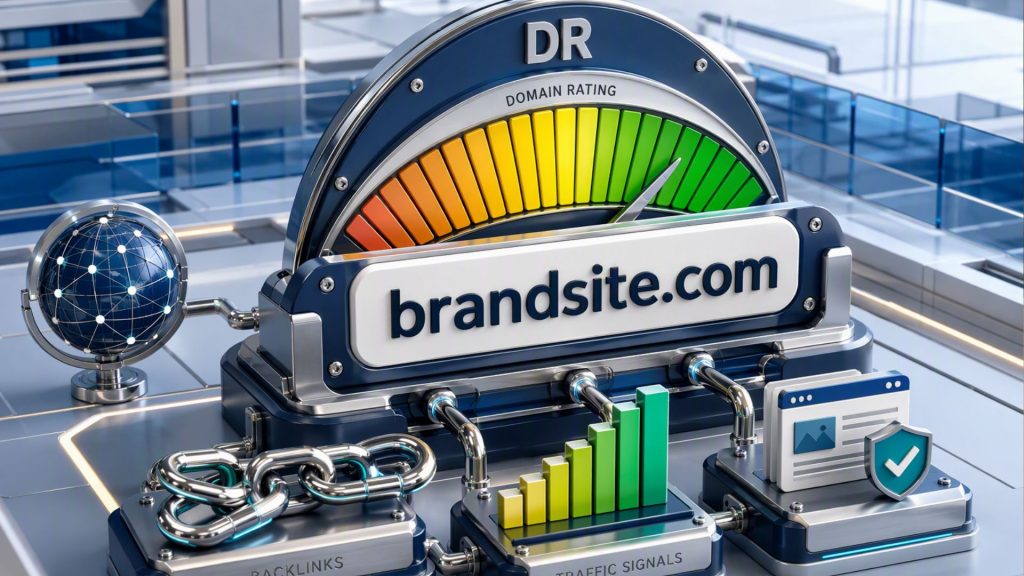
Domain Rating is Ahrefs’ proprietary metric for estimating the relative strength of a website’s backlink profile on a 0–100 scale. Ahrefs calculates it based on the quality and quantity of referring domains, as well as how widely those sites link out. A backlink from a well-regarded website that links to only a few other sites can carry more weight than one from a high-DR site linking to thousands of domains.
DR is useful because it gives buyers a quick way to compare backlink strength. But it has clear limits:
- It is not a Google ranking factor.
- It does not measure content quality, brand trust, conversions, or relevance.
- It is a domain-level metric, so it does not show which individual pages earned the links.
- It can change even if the site itself has not changed.
Ahrefs also describes DR as a relative metric. A score is only meaningful when compared with similar websites in the same market.
What Is a Good DR Score When Buying a Domain?
DR 0–10: Usually Limited Inherited SEO Value
This range often indicates a new, previously unused, or lightly linked site. It is not necessarily a poor purchase, especially when the name is short, brandable, or commercially relevant.
However, buyers should not expect meaningful inherited SEO value. The case for buying it should rest on the name and its fit for the business, not its backlink profile.
DR 10–30: Often Worth Investigating
This range can include strong opportunities, particularly in narrow industries where even established competitors do not have very high DR scores.
A clean DR 15 profile with a small number of relevant editorial links can be more useful than a DR 40 profile built on directories, sitewide placements, or unrelated sources. Review the referring domains, historical topic, and past organic visibility before making a decision.
DR 30–50: A Reasonable Range for Established Opportunities
A score in this range usually suggests a more developed backlink profile and a broader set of referring domains. For many buyers, it is a practical range to investigate when the former site is relevant to the project they plan to build.
The score still needs support from the underlying evidence. Confirm that the strongest links are credible, that the content matches your intended topic, and that the site has genuine organic visibility.
DR 50+: Strong Signal, But Not an Automatic Premium
A DR above 50 can indicate substantial backlink authority, but it often comes with a higher asking price. Treat the score as a reason for deeper due diligence, not as proof that the name is worth a premium.
Verify where the authority came from, whether the strongest linked pages can be recreated responsibly, and whether the former site’s topic connects to your planned use. A DR 60 site with spam-heavy anchors, no relevant traffic, or an unrelated history may be a worse purchase than a clean DR 20 option.
For most buyers, the strongest opportunities are not necessarily the highest-DR names. They are the ones with enough authority to be useful, a clean and relevant history, and evidence that supports the price being asked.
What Actually Determines Whether a Domain Is Worth Buying?
DR can help you shortlist options, but it does not determine value. A worthwhile purchase has relevant authority, a credible history, real search visibility, and a clear fit for the site you plan to build.
Topical Relevance
The former site should relate to your planned project, audience, or industry. A cybersecurity site is generally a stronger fit for a new cybersecurity resource than an unrelated travel blog with the same DR. Review archived versions of the homepage and key pages. Look for a consistent topic and a logical connection between the former content, its backlinks, and your intended use. The wider the topic gap, the less useful its inherited signals are likely to be.
Backlink Quality and Referring Domains
Do not judge the profile by backlink volume. Focus on the quality and relevance of unique referring domains. Check whether its strongest links come from active, credible websites and appear naturally within useful content. Be cautious of authority driven mainly by sitewide links, directories, blog comments, or pages that link to large numbers of unrelated sites.
Review anchor text as well. Brand names, URLs, and natural topical phrases are normal. Repeated exact-match commercial terms or unrelated gambling, adult, pharmaceutical, and foreign-language anchors require closer review.
Organic Traffic and Search Visibility
Traffic helps show whether the site previously met real search demand. Review historical trends, ranking keywords, and the pages that attracted visitors. A decline after abandonment may be recoverable. But if traffic depended on outdated, irrelevant, or low-quality pages, do not assume it will return. A high-DR domain with no relevant visibility should not command a premium without a clear explanation.
Historical Use and Reputation
Check archived versions to see how the site was used over time. A consistent purpose and credible content are positive signs. Repeated changes in topic, language, or purpose can indicate a repurposed or manipulated asset. Also search the name for prior brands, spam complaints, negative coverage, and trademark conflicts. A clean reputation and a coherent history often matter more than a modest difference in DR.
When a High DR Should Make You Walk Away
A high DR is not a reason to buy. In some cases, it is the reason to investigate more carefully.
Treat the opportunity as high risk when several of these signals appear together:
- The site has a high DR but little or no relevant organic visibility.
- Most authority comes from sitewide, directory, forum-profile, or clearly non-editorial links.
- Anchor text is dominated by exact-match commercial terms or unrelated gambling, adult, pharmaceutical, or foreign-language phrases.
- Referring domains rose sharply over a short period, then disappeared or stopped growing.
- The strongest links point to pages you cannot restore or replace with a relevant, useful equivalent.
- Archived versions show repeated changes in topic, language, or purpose.
- Historical pages contain large volumes of unrelated outbound commercial links.
No older site has a flawless backlink profile. The issue is whether the problems are isolated or form a pattern. If the score cannot be explained by relevant content, credible mentions, and a consistent history, do not pay a premium for it.
DR vs. Domain Authority: Which Metric Should You Use?
Use the metric available in the tool you trust for backlink analysis, but do not use either DR or Domain Authority (DA) as a standalone buying signal.
DR is Ahrefs’ measure of a site’s relative backlink-profile strength. DA is Moz’s equivalent authority metric. Both use a 0–100 scale, but they rely on different link indexes and proprietary calculations. A DR 40 is not the same thing as a DA 40, and one cannot be converted into the other.
For buyers, DR is often more useful when Ahrefs is also being used to inspect referring domains, anchors, link growth, and organic traffic. The score then acts as a quick entry point to the same data set you will use for due diligence.
DA can serve as a second opinion. If both metrics suggest a strong profile, that may support further review. If they differ sharply, do not average them or assume one is incorrect. Treat the gap as a prompt to inspect the underlying links more closely. Different databases may have found different links, weighted them differently, or updated at different times.
Can You Buy an Expired Domain for SEO?
You can buy an expired domain, but your intended use matters.
Google’s spam policies specifically address expired domain abuse: purchasing an expired name and repurposing it mainly to manipulate search rankings by hosting low-value content. Google’s current spam policies state that this is considered spam.
That does not mean every acquisition is a problem. There are legitimate reasons to buy an expired name:
- Continuing a useful site or community
- Rebuilding valuable resources for the same audience
- Acquiring a relevant business asset
- Preserving a brand or product name
- Publishing genuinely useful content that matches the site’s established purpose
The difference is whether the project offers real value to users. Buying a high-DR name, publishing unrelated low-quality articles, and relying on inherited links is not a durable strategy.
If you acquire a relevant site, maintain topical continuity where it is meaningful. Recreate useful pages when possible, and use redirects only when there is a clear, user-focused equivalent destination.
Conclusion
There is no single DR score that makes a domain worth buying. Use it to narrow your options, then assess the evidence behind it.
A clean, relevant site with credible links, a consistent history, and a practical fit for your project is usually a better purchase than a higher-DR option with unclear authority or hidden risk. Buy the foundation, not the metric.